
India's economic growth rate is expected to be at least 6 per cent in the 2013-14 fiscal, Prime Minister's Economic Advisory Council (PMEAC) Chairman C Rangarajan said.
One of the major contributors for the decline in growth will be the monsoon deficiency, which also affects non- agricultural sectors through demand effects, RBI report said.

The steep decline in commodity prices has reversed.

Rajan's appointment will be perceived as a positive development.

Assume that the rupee will trend lower over the next 10 years as India increases overseas sovereign exposures, and your long-term asset allocation should be geared to deal with this trend, suggests Devangshu Datta

Non-performing loans in the Chinese banking system stood at RMB 1.27 trillion at the end of 2015.

Despite the gains from Jet's closure, in 2018 and 2019, the airline continued to make losses in many quarters for a variety of reasons, including some mistakes like taking on Jet's aircraft, which were not in great shape and had business class configuration, a gamble that did not work for SpiceJet.

The global brokerage firm believes that CRR cut is likely to help cut lending rates and revive growth sentiments.

Index heavyweight RIL surged 3% to end above Rs 1,000 mark while IT majors were also the top gainers.

Corporates' forex borrowings have grown at a CAGR of 15.6% since 2008.
Financial services firm AnandRathi analysed the key points of the policy soon after it was announced.

We are much better placed than in 2013 with our overall fundamentals much stronger - higher foreign exchange reserves, a more favourable growth-inflation mix and an institutional framework for targeting inflation, says B Prasanna.

In the Sensex pack, Axis Bank, Tata Motors, Infosys, Kotak Bank, HDFC Bank, RIL, Bajaj Auto, SBI, HUL, Tata Steel, Vedanta, HFDC, TCS, ITC and Sun Pharma jumped up to 4.64 per cent.

A lower opening at the domestic equity market and the dollar's rise against other major currencies overseas also put pressure on the rupee, dealers said.
The Reserve Bank on Friday said the economy would grow by 5 to 5.5 per cent in the current fiscal, pinning its hopes on good farm output and improved exports.

As global markets near all-time highs driven by liquidity, Marc Faber suggests most asset prices worldwide are inflated.

Apart from SIPS and STPS, value- averaging can help investors make more money, says Devangshu Datta.

Cascading effect of rising raw materials will result in inflation, high rates, slow capex

US Fed rate rise raises risk of further drying up of FII flows.
Heavy unwinding by foreign portfolio investors and lacklustre equities dampened the sentiment

The RBI opened a forex swap window in August to meet the entire daily dollar requirements of three oil marketing companies as the rupee depreciated to an all-time low of 68.85 against the US currency.

Though inflation, on the basis of the wholesale price index, is nowhere near the 1990-91 level of 10.26 per cent and India is in a much better position to check it, the greater integration of our economy with the globe has exposed it to a much higher risk of imported inflation.
.jpg)
The rupee gained 8 paise to close at over two-week high of 61.23 against the US dollar in the previous session.

Higher interest rates in the US do not necessarily coincide with capital outflows.

Dollar gained against major currencies overseas.

Foreign investors are betting top dollar on the country as growth is likely to recover at a time when other emerging markets are battling macroeconomic adjustments.

Bank credit growth, still sluggish, could see a rise if the Reserve Bank of India decides to cut interest rates, believes Ashima Goyal.

In a recent article, Rajan has ridiculed critics of the exchange rate policy.

IMF attributes the slower growth rate to supply-side bottlenecks.

Ongoing trade-war rhetoric between the US and China added some nervousness on the trading front coupled with extremely bullish dollar sentiment overseas.

The majority in the markets believe that a September lift-off is likely.

Faced with sluggish economic growth and dwindling exports, China on Wednesday devalued its currency for the second consecutive day.

The Budget has to provide for capex on roads, railways, defence and other infrastructure sectors.

It won't be an easy ride for the markets, reckon experts, considering the multiple state elections in 2018 and general elections next year.

RBI is expected to cut policy rates by 50 basis points by 2016.
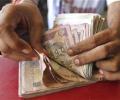
Month end dollar demand from oil importers has forced rupee to trade weak.

Nifty ends above 8,400; TCS, HDFC surge 2%, Bajaj Auto dips 2%.

These investors have pumped in about Rs 6,900 crore (Rs 69 billion) in the seven trading sessions after the Federal Open Market Commission meet.

The interim dividend will help Narendra Modi-led government partly bridge the deficit its budget had developed after the announcement of a Rs 75,000 crore a year cash dole scheme for small farmers.
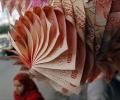
The rupee has depreciated by about 25 per cent in the past three months, from close to Rs 83 in mid-May, while it was even higher at about Rs 80 against the British Pound in March.
